



Industry News
How to Manufacture Industrial?Scale Large Essential Oil Extractors
DATE:2026-05-11
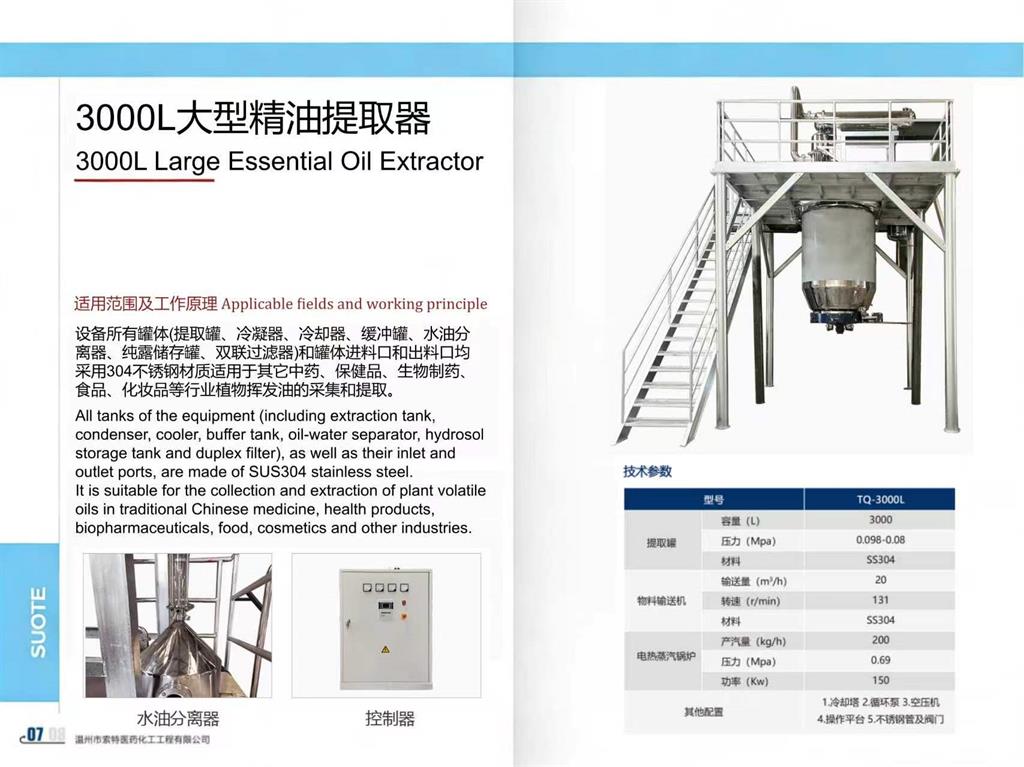
The mainstream industrial large‑scale essential oil extractors are complete steam distillation sets, with single‑tank volumes ranging from 500L to 10,000L. The whole machine is made of 304/316 stainless steel, supporting continuous or batch production, and suitable for large‑scale extraction of lavender, rose, sandalwood, mugwort, eucalyptus, citronella and other plants. Below is a full introduction covering core structure, manufacturing materials, processing technology, assembly, control system and auxiliary systems.
I. Core Structure of the Whole Machine
1. Distillation Extraction Tank
• Volume: 500L / 1000L / 2000L / 5000L / 7000L / 10000L
• Material: Food‑grade 304/316L stainless steel; internal mirror polishing with Ra ≤ 0.8μm, no sanitary dead corners, complying with GMP standards
• Structure: Vertical cylindrical shape with jacket heating layer (for steam/thermal oil circulation); quick‑opening manhole on the top for feeding; automatic residue discharge outlet at the bottom; built‑in steam distribution plate and material basket (for holding flowers, herbs or wood chips to ensure even steam penetration); equipped with temperature, pressure and liquid level sensors, and explosion‑proof sight glass
• Heating methods: Industrial boiler saturated steam (0.1–0.3MPa, 100–130℃, preferred), thermal oil, electric heating
• Pressure resistance: Normal pressure – 0.3MPa; optional vacuum distillation (-0.08MPa) for low‑temperature protection of heat‑sensitive essential oils
2. Demister
Installed on the top of the distillation tank to remove plant dust and macromolecular impurities from steam, preventing essential oil turbidity and improving purity.
3. Condenser (Core Heat‑Exchange Component)
Industrial tubular or coil‑type condenser with heat exchange area matched to tank volume (e.g., 40–60㎡ for a 7000L tank)
• High‑temperature oil‑gas flows inside, and industrial circulating cooling water (20–30℃) circulates outside
• Function: Rapidly cools oil‑gas into oil‑water mixture to avoid thermal decomposition and volatile loss of essential oils
4. Oil‑Water Separator
Multi‑stage gravity industrial standard oil‑water separator with sight glass, overflow outlet and drainage outlet
• Principle: Essential oil floats automatically due to lower density than water; pure hydrosol is discharged and recycled from the lower layer, while essential oil overflows and is collected from the upper layer
• Separation efficiency: ≥99%; centrifugal separator can be added to large‑scale equipment to accelerate separation
5. Hydrosol & Essential Oil Storage Tanks
Stainless steel storage tanks for separate storage of essential oil and hydrosol; hydrosol can be re‑distilled for further oil extraction.
6. Operating Platform & Frame
Stainless steel supports, ladders and guardrails for high‑altitude operation of large tanks.
II. Complete List of Manufacturing Materials
1. Main plates: 304/316L stainless steel plates (thickness 4–10mm)
2. Heat‑exchange parts: Seamless stainless steel tubes, tubular tubes, coils
3. Seals: Food‑grade silicone gaskets, fluororubber seals
4. Valves: Pneumatic/electric ball valves, check valves, exhaust valves, blowdown valves
5. Instruments: Temperature sensors, pressure gauges, liquid level meters, flow meters
6. Pipelines: 304 seamless stainless steel pipes, flanges, elbows
7. Control system: PLC touch screen, frequency converter, contactors, alarm modules
8. Auxiliary equipment: Circulating water pumps, cooling towers, steam generators, optional vacuum pumps
III. Manufacturing & Processing Procedures
1. Tank Fabrication
1. Roll steel plates into cylinders, weld and polish internal & external welds to ensure sealing and pressure resistance
2. Weld steam jacket and conduct hydraulic pressure test (0.4–0.6MPa pressure holding for 30min with no leakage)
3. Drill openings for feeding, residue discharge, steam inlet, oil‑gas outlet, temperature measurement and blowdown
4. Install internal components: steam distributor, material basket, optional stirring paddles for raw material dispersion
2. Condenser Fabrication
Assemble and weld tubular parts, conduct hydraulic pressure and air tightness tests to ensure no water or air leakage.
3. Oil‑Water Separator Fabrication
Multi‑chamber structure with precisely designed overflow height adapted to essential oil density for automatic layered collection.
4. Pipeline & Valve Installation
Arrange pipelines according to process flow; connect via welding or flanges; install valves and instruments; conduct overall air tightness test.
5. Electrical Automatic Control System Assembly
PLC touch screen control cabinet enables automatic temperature/pressure control, steam flow regulation, distillation timing and full‑automatic cooling water control. Equipped with alarms for over‑temperature, over‑pressure, water shortage and overload, power‑failure protection, formula storage and remote monitoring support.
6. Overall Assembly & Commissioning
Assemble tanks, condensers, separators, storage tanks and frames as a whole. Conduct trial runs with water and steam, adjust distillation duration, temperature and cooling parameters; deliver after stable oil output.
IV. Complete Working Process
1. Raw Material Pretreatment: Cut or crush flowers, herbs or wood chips and load into the basket of the distillation tank
2. Heating & Distillation: Heat via jacket steam; water vapor penetrates raw materials and carries essential oil to form oil‑gas mixture
3. Demisting: Remove impurities and dust
4. Condensation: Oil‑gas enters the condenser and cools into oil‑water mixture
5. Oil‑Water Separation: Mixture flows into the separator; essential oil floats for collection while lower‑layer hydrosol is recycled
6. Residue Discharge: Automatically discharge residues from the bottom after distillation; clean the tank for next batch production
V. Optional Upgrades
1. Vacuum Distillation: Low‑temperature extraction (60–80℃) to preserve aroma of heat‑sensitive essential oils such as rose and jasmine
2. Dual Condensation System: Primary pre‑cooling + secondary deep cooling to increase oil yield by over 20%
3. Continuous Production Line: Automatic feeding‑distillation‑residue discharge for 24‑hour continuous operation
4. Supercritical CO₂ Extraction: For high‑end agarwood and sandalwood essential oils; high purity without high‑temperature damage
VI. Key Process Parameters
• Distillation temperature: 95–120℃ (normal pressure); 60–85℃ (vacuum)
• Steam pressure: 0.1–0.2MPa
• Cooling water temperature: ≤30℃
• Distillation duration: 2–6 hours per batch (adjusted by raw materials)
• Oil yield: Lavender 0.8–1.5%, rose 0.03–0.05%, eucalyptus 1.5–2.5%